Finally a day off! It's been a brutal week with me catching the 4th flu of the year (I really have got to get out of Riverside, CA before too long. I had gone 3 yrs without a flu before I moved up here last December. This place is really bad for me!), but still having to go back to work the first day after the fever finally broke. It seemed the whole town of Redlands knew the Thai resto I've been working at finally had a bartender in residence again after 4 days, and we were absolutely swamped for 3 straight days. I'm telling you, people start drinking martinis and other hard core cocktails at lunch time here!
Anyhow, I somehow survived, but was quite something of a post-halloween zombie this morning until I stumbled onto this awesome audio upload of the Alcina broadcast from the Paris Opera in 2004. It stars Luba Orgonasova (Alcina), Vesselina Kasarova (Ruggiero), Vivica Genaux (Bradamante), Patrizia Ciofi (Morgana), Toby Spence (Oronto), and Luca Pisaroni (Melisso)!
That was VK's first foray into the Handelian repertoire, I think, and a marvelous treat to start a day off with!
Showing posts with label Smorg's favorite singers. Show all posts
Showing posts with label Smorg's favorite singers. Show all posts
Sunday, November 6, 2016


Thursday, August 11, 2016
Innsbruck, of all places!
By now most of my fellow fans of the Bulgarian - Swiss operatic mezzo soprano Vesselina Kasarova would probably have heard of her run in, a few days ago, with a couple of muggers in Innsbruck ahead of her scheduled performances as Fidalma in Cimarosa's Il matrimonio segreto. Frau Kasarova is one tough cookie and operatically screamed off her attackers, but not before getting roughed up enough to require the cancellation of her appearance and a return home to recuperate.
She is reportedly recovering okay, considering the circumstances. We fans are still quite shocked by the incident, of course! (Honestly... of all places for this to happen!) I'm personally in awe as to how well she handled the whole experience. Shame on the two perpetrators and may they never forget her voice.
Sending the White Shirt Republic's favorite dame all the best of wishes for a complete and speedy recovery. Gute Besserung, Frau Kasarova!
She is reportedly recovering okay, considering the circumstances. We fans are still quite shocked by the incident, of course! (Honestly... of all places for this to happen!) I'm personally in awe as to how well she handled the whole experience. Shame on the two perpetrators and may they never forget her voice.
Sending the White Shirt Republic's favorite dame all the best of wishes for a complete and speedy recovery. Gute Besserung, Frau Kasarova!
Monday, May 2, 2016
Guest Review: Vesselina Kasarova in Verdi's Rigoletto at Opera Bastille
The following review of the current run of Verdi's Rigoletto (with particular attention on our mutual favorite singer, Vesselina Kasarova) in Paris is guest-posted here courtesy of John Carnegie of Scotland. Thanks very much, John!
VESSELINA KASAROVA IN “RIGOLETTO” AT THE OPÉRA BASTILLE IN PARIS ON 14TH APRIL 2016
Through shuffling round work assignments, I managed to attend the second performance of the Opéra National de Paris’s new production of Verdi’s Rigoletto at their unlovely Opéra Bastille venue – a vast and gloomy barn of a building that makes the New York MET seem almost intimate by comparison.
Vesselina Kasarova was billed to play the comparatively minor role of Maddalena, the assassin’s sister/accomplice who causes the downfall of the title character and his daughter by succumbing to the charms of the opera’s philandering baddie, the Duke. Given that Maddalena does not show up on stage until the very last scene of a long evening and that VK had cancelled her announced appearances on the two previous occasions that I had booked to see her, there was always a doubt in my mind as to whether she would turn up this time for a task that might seem somewhat beneath her. On the other hand, the fact that Maddalena is a prominent participant in the Quartet (for my money, the single most sublime passage of music in the whole history of opera) made for a compelling reason to hope against hope that VK might actually appear. Well, she did and to great effect.
Before one got through to her eventual entrance, however, one had to surmount the hurdles of the visuals on offer. Claus Guth was on directing duties and his typically high concept piece of “regie-theater” proved to be a very mixed blessing. The curtain rose at the start to reveal the figure of “Rigoletto’s Double”, a mimed role who represented Rigoletto looking back retrospectively on the events of the opera by mourning over the contents of a brown cardboard box he carried: his ex-jester’s costume and the blood-stained robe of his deceased daughter. This distracting figure was onstage throughout the evening and his non-stop gurning succeeded in constantly pulling the focus from Quinn Kelsey’s portrayal of the singing version of the title character.
As the set unfurled around the “Double”, it quickly became evident that it represented a gigantic sideways version of the cardboard box he carried. Brown cardboard is a very drab surface indeed and (combined with mostly monochrome costumes) made for a visually dull experience. However, that proved to VK’s great benefit. When she made her entrance in sparkling black thigh-high boots, a tight-fitting jump suit surmounted by a top hat a la Marlene Dietrich and carrying off a choreographed Las Vegas-inspired routine backed by a bevy of half-naked showgirls, this was the first visual excitement of the evening and the audience rose to the spectacle and VK’s panache in accomplishing it. This compensated for the fact that she was having to deal with the inconsiderate accompaniment of Nicola Luisotti – one of the breed of conductors whose head is mostly in the score and rarely paying attention to the performers on the stage. He spent much of the evening drowning out the singers with his vast orchestra. Fortunately, VK managed to gradually overcome this unwarranted competition – first in a very telling contribution to the Quartet and then in her successful attempt to put some backbone into Rafał Siwek’s dour assassin. Her portrayal could definitely be counted as a success and was richly rewarded with the audience’s applause at the curtain call.
As for the three principal roles, Quinn Kelsey made for a touching Rigoletto and often managed to command the stage (despite the distractions of his “Double”). Michael Fabiano’s Duke was a less compelling assumption and was the singer who suffered most from being swamped by the orchestra. Still, he perked up greatly in the last act – spurred on perhaps by the attentions of VK and the dancing showgirls. The star of the evening though was Olga Peretyatko’s Gilda: pin-sharp in her coloratura and hugely affecting throughout. Her final appearance was particularly moving. In one of Herr Guth’s happier inventions, Gilda does not spend her last minutes onstage in a sack but as a disembodied spirit diagonally traversing the stage as she disappears from her father into eternity. It was not just Ms Peretyatko’s nationality, talent and looks but also her manner that brought to mind a young Anna Netrebko. The packed audience took her to their collective hearts and gave her a huge round of applause at the curtain call. It was notable that VK (who has always been demonstrably appreciative of her fellow performers onstage) was particularly enthusiastic in her applause for Ms Peretyatko.

The current run of performances of Rigoletto in Paris is playing through to the end of May and VK (unlike her fellow principals) is scheduled to appear in all of them. If you go on the 14th and 30th of May, you will not get the benefit of Ms Peretyatko’s Gilda but you will at least be spared Mr Luisotti’s conducting. So, is it worth braving the travails of getting through the oppressive security arrangements of contemporary Paris (post Charlie Hebdo, the most militarised city in the western world) and enduring some of the vagaries of Herr Guth’s production? On the whole (and particularly for VK and Olga Peretyatko), I would say yes.
*******
VESSELINA KASAROVA IN “RIGOLETTO” AT THE OPÉRA BASTILLE IN PARIS ON 14TH APRIL 2016
Through shuffling round work assignments, I managed to attend the second performance of the Opéra National de Paris’s new production of Verdi’s Rigoletto at their unlovely Opéra Bastille venue – a vast and gloomy barn of a building that makes the New York MET seem almost intimate by comparison.
Vesselina Kasarova was billed to play the comparatively minor role of Maddalena, the assassin’s sister/accomplice who causes the downfall of the title character and his daughter by succumbing to the charms of the opera’s philandering baddie, the Duke. Given that Maddalena does not show up on stage until the very last scene of a long evening and that VK had cancelled her announced appearances on the two previous occasions that I had booked to see her, there was always a doubt in my mind as to whether she would turn up this time for a task that might seem somewhat beneath her. On the other hand, the fact that Maddalena is a prominent participant in the Quartet (for my money, the single most sublime passage of music in the whole history of opera) made for a compelling reason to hope against hope that VK might actually appear. Well, she did and to great effect.
Before one got through to her eventual entrance, however, one had to surmount the hurdles of the visuals on offer. Claus Guth was on directing duties and his typically high concept piece of “regie-theater” proved to be a very mixed blessing. The curtain rose at the start to reveal the figure of “Rigoletto’s Double”, a mimed role who represented Rigoletto looking back retrospectively on the events of the opera by mourning over the contents of a brown cardboard box he carried: his ex-jester’s costume and the blood-stained robe of his deceased daughter. This distracting figure was onstage throughout the evening and his non-stop gurning succeeded in constantly pulling the focus from Quinn Kelsey’s portrayal of the singing version of the title character.
As the set unfurled around the “Double”, it quickly became evident that it represented a gigantic sideways version of the cardboard box he carried. Brown cardboard is a very drab surface indeed and (combined with mostly monochrome costumes) made for a visually dull experience. However, that proved to VK’s great benefit. When she made her entrance in sparkling black thigh-high boots, a tight-fitting jump suit surmounted by a top hat a la Marlene Dietrich and carrying off a choreographed Las Vegas-inspired routine backed by a bevy of half-naked showgirls, this was the first visual excitement of the evening and the audience rose to the spectacle and VK’s panache in accomplishing it. This compensated for the fact that she was having to deal with the inconsiderate accompaniment of Nicola Luisotti – one of the breed of conductors whose head is mostly in the score and rarely paying attention to the performers on the stage. He spent much of the evening drowning out the singers with his vast orchestra. Fortunately, VK managed to gradually overcome this unwarranted competition – first in a very telling contribution to the Quartet and then in her successful attempt to put some backbone into Rafał Siwek’s dour assassin. Her portrayal could definitely be counted as a success and was richly rewarded with the audience’s applause at the curtain call.
As for the three principal roles, Quinn Kelsey made for a touching Rigoletto and often managed to command the stage (despite the distractions of his “Double”). Michael Fabiano’s Duke was a less compelling assumption and was the singer who suffered most from being swamped by the orchestra. Still, he perked up greatly in the last act – spurred on perhaps by the attentions of VK and the dancing showgirls. The star of the evening though was Olga Peretyatko’s Gilda: pin-sharp in her coloratura and hugely affecting throughout. Her final appearance was particularly moving. In one of Herr Guth’s happier inventions, Gilda does not spend her last minutes onstage in a sack but as a disembodied spirit diagonally traversing the stage as she disappears from her father into eternity. It was not just Ms Peretyatko’s nationality, talent and looks but also her manner that brought to mind a young Anna Netrebko. The packed audience took her to their collective hearts and gave her a huge round of applause at the curtain call. It was notable that VK (who has always been demonstrably appreciative of her fellow performers onstage) was particularly enthusiastic in her applause for Ms Peretyatko.

The current run of performances of Rigoletto in Paris is playing through to the end of May and VK (unlike her fellow principals) is scheduled to appear in all of them. If you go on the 14th and 30th of May, you will not get the benefit of Ms Peretyatko’s Gilda but you will at least be spared Mr Luisotti’s conducting. So, is it worth braving the travails of getting through the oppressive security arrangements of contemporary Paris (post Charlie Hebdo, the most militarised city in the western world) and enduring some of the vagaries of Herr Guth’s production? On the whole (and particularly for VK and Olga Peretyatko), I would say yes.
*******
Thursday, May 7, 2015
Guest review: La voix humaine and Bluebeard's Castle in Wiesbaden
Guest review courtesy of Mr John Carnegie, submitted promptly and all the delay is down to yours truly's tardiness in reformatting and minor editing stuff. Thank you, John!
VESSELINA KASAROVA IN “DUKE BLUEBEARD’S CASTLE” AT THEHESSISCHES STAATSTHEATER IN WIESBADEN ON 19TH APRIL 2015
The week beginning Sunday 19th April was due to be one of the busiest in Vesselina Kasarova’s schedule this year: two performances of Mahler’s Das Lied von der Erde given between her first two performances as Judit in Bartók’s one act opera Duke Bluebeard’s Castle. I managed to contrive that I had to be nearby in Germany during the week and had booked for the opening performance of the Bartók and the second of the Mahler ones. However, VK cancelled both of her Mahler performances –ostensibly through illness. So I’m afraid that I am only able to report on her performance in the Bartók.
If she had taken part in the concert in the Beethoven-Saal in Stuttgart’s Leiderhalle, she would have experienced an excellent fellow soloist (Stephen Gould – the first tenor I have encountered who has managed to ride over the orchestra in the notoriously taxing first song), a meticulous conductor (Gabriel Feltz – whose concern for incisive detail was perhaps at the expense of the broader flow of the piece as a whole) and a superb orchestra (the Stuttgarter Philharmoniker – who were at home with this music in a way they weren’t quite in the Mozart symphony that constituted the first half of the programme). On the other hand, VK would have found an unfocussed and inattentive audience – unsettled perhaps by the curious architecture of the Beethoven-Saal in which there is not a single instance of symmetry.
.jpg)
As the full orchestra was not required for the Mozart, I found myself sitting next to one of the violin sections as I opened my programme to discover that Janina Baechle was to substitute for VK. Upon hearing my exclamation of disappointment at reading this announcement, the violinist assured me that Fraulein Baechle was by no means an inferior substitute – which indeed turned out to be the case. However, given VK’s evident vocal health in Wiesbaden on the previous Sunday, I was curious to learn from the violinist that Fraulein Baechle was already in place the very next morning for rehearsals for the first of the Mahler performances in Aschaffenburg on Tuesday.
Anyway, on a happier note, on to the Bartók. The Hessisches Staatstheater inWiesbaden is like a smaller version of the Zűrich Opernhaus at which VK had (until recently) been such a fixture, she must have felt very comfortable performing there. However, given that Duke Bluebeard’s Castle is one of my favourite operas and that some of VK’s recent performances (such as the patchy recital in Amsterdam and her somewhat underwhelming CD rendition of La mort de Cléopâtre) have been less than perfect, I admit that I arrived at the Staatstheater prepared to be disappointed. I need not have worried. For her, the evening was a triumph on the level of her superb Romeo opposite Anna Netrebko in Munich or her assured contribution to that delightful recent China meets Europe CD.
.jpg) However, despite a nearly full and buzzingly expectant audience, the
evening did not start auspiciously. The first half of the double bill
was a performance of Poulenc’s LaVoix Humaine. It starred (and I use the
word advisedly) Julia Migenes as the solitary female who is the only
onstage character in this rarely performed piece based on the Jean
Cocteau monodrama. Ms Migenes’s previous fame had been the principal
focus of the publicity campaign to sell the double bill and she was
being feted the following evening with a gala performance at the local
art house cinema of the film of Carmen in which she appeared opposite
Domingo. However, on the evidence of the Poulenc, she is now very much a
faded star. She still has manifest stage presence but played the
protagonist on an unvaried note of petulance throughout and she
under-projected much of the text.
However, despite a nearly full and buzzingly expectant audience, the
evening did not start auspiciously. The first half of the double bill
was a performance of Poulenc’s LaVoix Humaine. It starred (and I use the
word advisedly) Julia Migenes as the solitary female who is the only
onstage character in this rarely performed piece based on the Jean
Cocteau monodrama. Ms Migenes’s previous fame had been the principal
focus of the publicity campaign to sell the double bill and she was
being feted the following evening with a gala performance at the local
art house cinema of the film of Carmen in which she appeared opposite
Domingo. However, on the evidence of the Poulenc, she is now very much a
faded star. She still has manifest stage presence but played the
protagonist on an unvaried note of petulance throughout and she
under-projected much of the text.
.jpg)
After this, the Bartók came as a great relief. Granted the (very good) Hessisches Staatsorchester is much smaller than the vast forces specified by the composer but a bigger band might have overwhelmed the theatre’s acoustics. As it was, there wasn’t enough room for them all in the pit and the harps had to take their places in a box –giving their part on unexpected prominence. The production turned out to be one of the best of the many versions of the opera I have seen. Uwe Eric Laufenberg (who is also the theatre’s Intendant) was clearly influenced (how could he not be?) by the opera’s close parallels with the currently trendy Fifty Shades of Grey. Bluebeard’s castle becomes his top floor penthouse accessed by lift. VK’s Judit enters into it with an Anastasia Steele-like fascinated faux innocence. The opening of the first door (to Bluebeard’s torture chamber) becomes the opening of his laptop to reveal the hidden images there. At the end, in a dubiously distinct departure from Bartók’s reinvention of the original legend, Bluebeard’s former wives are ghosts rather than still living and Bluebeard stabs Judit to death before she herself becomes a ghost.
The Staatstheater’s Music Director Zsolt Hamar was on conducting duties that evening and a very precise and inspiring job he made of it. As Bluebeard, Gerd Grochowski (who will play Wagner’s Dutchman at Wiesbaden next season) proved to be a most acceptable substitute for the previously announced Johannes Martin Kränzle. Subdued at first (and quite rightly so in terms of both production and opera), he developed stature from the opening of the fifth door onwards into the reluctant dominance required by the text.
.jpg)
However, the emotional and artistic centre of the performance was VK’s Judit. Looking much younger than her years, she succeeded in capturing all the facets of Judit’s complex character from wide-eyed fascination to shocked acceptance of the horrendous bargain she has made. Vocally, there was scarcely a trace of the all too audible inbreathing problems she had been displaying of late and she easily managedto impose herself over even the most extreme moments of orchestration. Of particular note was her subtly stunned realisation on the opening of fourth door (the garden of flowers) of a sense of utter hopelessness. This was the pivotal moment in what was arichly satisfying portrayal.
.jpg)
At the end of the performance, it was audibly clear that – despite Ms Migenes’s somewhat presumptively grandstanding re-entry into the centre of the curtain call line-up – it was VK who got by far the biggest ovation during the solo calls.
.jpg)
All in all then, a marvellous evening for VK and she was visibly delighted by the result. She is due to perform in appear in three out of the four performances of the production in Wiesbaden in June. Provided that she turns up, anybody who can make it along will be richly rewarded.
VESSELINA KASAROVA IN “DUKE BLUEBEARD’S CASTLE” AT THEHESSISCHES STAATSTHEATER IN WIESBADEN ON 19TH APRIL 2015
The week beginning Sunday 19th April was due to be one of the busiest in Vesselina Kasarova’s schedule this year: two performances of Mahler’s Das Lied von der Erde given between her first two performances as Judit in Bartók’s one act opera Duke Bluebeard’s Castle. I managed to contrive that I had to be nearby in Germany during the week and had booked for the opening performance of the Bartók and the second of the Mahler ones. However, VK cancelled both of her Mahler performances –ostensibly through illness. So I’m afraid that I am only able to report on her performance in the Bartók.
If she had taken part in the concert in the Beethoven-Saal in Stuttgart’s Leiderhalle, she would have experienced an excellent fellow soloist (Stephen Gould – the first tenor I have encountered who has managed to ride over the orchestra in the notoriously taxing first song), a meticulous conductor (Gabriel Feltz – whose concern for incisive detail was perhaps at the expense of the broader flow of the piece as a whole) and a superb orchestra (the Stuttgarter Philharmoniker – who were at home with this music in a way they weren’t quite in the Mozart symphony that constituted the first half of the programme). On the other hand, VK would have found an unfocussed and inattentive audience – unsettled perhaps by the curious architecture of the Beethoven-Saal in which there is not a single instance of symmetry.
As the full orchestra was not required for the Mozart, I found myself sitting next to one of the violin sections as I opened my programme to discover that Janina Baechle was to substitute for VK. Upon hearing my exclamation of disappointment at reading this announcement, the violinist assured me that Fraulein Baechle was by no means an inferior substitute – which indeed turned out to be the case. However, given VK’s evident vocal health in Wiesbaden on the previous Sunday, I was curious to learn from the violinist that Fraulein Baechle was already in place the very next morning for rehearsals for the first of the Mahler performances in Aschaffenburg on Tuesday.
Anyway, on a happier note, on to the Bartók. The Hessisches Staatstheater inWiesbaden is like a smaller version of the Zűrich Opernhaus at which VK had (until recently) been such a fixture, she must have felt very comfortable performing there. However, given that Duke Bluebeard’s Castle is one of my favourite operas and that some of VK’s recent performances (such as the patchy recital in Amsterdam and her somewhat underwhelming CD rendition of La mort de Cléopâtre) have been less than perfect, I admit that I arrived at the Staatstheater prepared to be disappointed. I need not have worried. For her, the evening was a triumph on the level of her superb Romeo opposite Anna Netrebko in Munich or her assured contribution to that delightful recent China meets Europe CD.
After this, the Bartók came as a great relief. Granted the (very good) Hessisches Staatsorchester is much smaller than the vast forces specified by the composer but a bigger band might have overwhelmed the theatre’s acoustics. As it was, there wasn’t enough room for them all in the pit and the harps had to take their places in a box –giving their part on unexpected prominence. The production turned out to be one of the best of the many versions of the opera I have seen. Uwe Eric Laufenberg (who is also the theatre’s Intendant) was clearly influenced (how could he not be?) by the opera’s close parallels with the currently trendy Fifty Shades of Grey. Bluebeard’s castle becomes his top floor penthouse accessed by lift. VK’s Judit enters into it with an Anastasia Steele-like fascinated faux innocence. The opening of the first door (to Bluebeard’s torture chamber) becomes the opening of his laptop to reveal the hidden images there. At the end, in a dubiously distinct departure from Bartók’s reinvention of the original legend, Bluebeard’s former wives are ghosts rather than still living and Bluebeard stabs Judit to death before she herself becomes a ghost.
The Staatstheater’s Music Director Zsolt Hamar was on conducting duties that evening and a very precise and inspiring job he made of it. As Bluebeard, Gerd Grochowski (who will play Wagner’s Dutchman at Wiesbaden next season) proved to be a most acceptable substitute for the previously announced Johannes Martin Kränzle. Subdued at first (and quite rightly so in terms of both production and opera), he developed stature from the opening of the fifth door onwards into the reluctant dominance required by the text.
However, the emotional and artistic centre of the performance was VK’s Judit. Looking much younger than her years, she succeeded in capturing all the facets of Judit’s complex character from wide-eyed fascination to shocked acceptance of the horrendous bargain she has made. Vocally, there was scarcely a trace of the all too audible inbreathing problems she had been displaying of late and she easily managedto impose herself over even the most extreme moments of orchestration. Of particular note was her subtly stunned realisation on the opening of fourth door (the garden of flowers) of a sense of utter hopelessness. This was the pivotal moment in what was arichly satisfying portrayal.
At the end of the performance, it was audibly clear that – despite Ms Migenes’s somewhat presumptively grandstanding re-entry into the centre of the curtain call line-up – it was VK who got by far the biggest ovation during the solo calls.
All in all then, a marvellous evening for VK and she was visibly delighted by the result. She is due to perform in appear in three out of the four performances of the production in Wiesbaden in June. Provided that she turns up, anybody who can make it along will be richly rewarded.
Monday, December 8, 2014
Just another viewing of Der Rosenkavalier with Kasarova
I'm over-indulging in the Zurich Der Rosenkavalier DVD again. :D You know how uncannily Vesselina Kasarova (Octavian) dominates the stage during opera performances? Have a look just at the final duet here (starting at around 5:06 in). She has the entire auditorium so naturally covered with eye contact without even breaking character... I mean, contrast this with the gorgeous Malin Hartelius (Sophie).
The latter is a most exquisite Sophie (so poised, so amazingly sung, so still, I can't love her enough), but she theatrically disenfranchises just about all the audience on the right side of the house since she only ever looks/faces the left side of the auditorium). VK, on the other hand, has the whole hall scanned by the end of the first section of final duet, and she even does a final sweep (08:30-40) before turning up-stage and walking off with Sophie. It's so cool how she does that without breaking character. Sophie may be oblivious to your presence, but Octavian knows you're there and he isn't just singing for Sophie, but for you also ... no matter where you are in the house!
What can I say? The gal is a genius!
The latter is a most exquisite Sophie (so poised, so amazingly sung, so still, I can't love her enough), but she theatrically disenfranchises just about all the audience on the right side of the house since she only ever looks/faces the left side of the auditorium). VK, on the other hand, has the whole hall scanned by the end of the first section of final duet, and she even does a final sweep (08:30-40) before turning up-stage and walking off with Sophie. It's so cool how she does that without breaking character. Sophie may be oblivious to your presence, but Octavian knows you're there and he isn't just singing for Sophie, but for you also ... no matter where you are in the house!
What can I say? The gal is a genius!
Friday, November 7, 2014
La Belle Kasarova
Vesselina Kasarova, demonstrating how to sing a PG13 rated operetta with a full blown x-rated voice... This is from the 2nd act of Jacques Offenbach's La Belle Helene (The Beautiful Helen) from Zurich Opera.
Apologies for harbor blockage upon playing the clip, the lass does have a reputation for causing spontaneous ship launches!
Apologies for harbor blockage upon playing the clip, the lass does have a reputation for causing spontaneous ship launches!
Wednesday, June 11, 2014
Guest Posting: Vesselina Kasarova at the Whitsun Festival in Salzburg
Below is a guest posting courtesy of John Carnegie (who also supplied all the photos) after attending the Whitsun Festival in Salzburg on June 8th, 2014. Thanks very much, John!
“ROSSINISSIMO”
FESTIVAL IN SALZBURG
Some people
experience what is known as a “three Kleenex movie”. Vesselina Kasarova has just had a three frock
evening in Salzburg.

Salzburg: that
city with its curious concoction of culture and kitsch; in which the streets
are paved with beggars studiously ignored by the penguin-suited culture
vultures who stroll by them; in which (see below) the birthplace of its
greatest son is situated above a Spar supermarket selling the ubiquitous
over-priced Mozart Kugel sweets that typify the city’s avidity for art
alongside its attempts to strip the tourist’s wallet of all its assets. Mozart famously couldn’t wait to flee the
place. One wonders what his reaction
would be to the contradictions on display there now.

For once though,
Salzburg’s cultural focus was not on Mozart but a composer born a year after
his death. For the third year running,
the city’s Pfingstfestspiele (Whitsun Festival) was being curated by Cecilia
Bartoli and her chosen theme for 2014 was the music of Rossini. Packed houses were the order of the day as
patrons stewed in the sweltering heat wave visited on the city. “Rossinissimo” (as the five day festival was
called) covered a broad range of the composer’s oeuvre: comic and tragic opera,
song, sacred music and not forgetting Rossini’s principal passion: food. The penultimate evening brought a host of
stars to Salzburg – with two concerts at 5pm and 8pm including Frau Kasarova
among the array.

The first of
these was at the Mozarteum and featured Rossini’s final composition, the Petite
Messe Solennelle, and the first of Frau Kasarova’s frocks for the evening:
a demure dark brown number that allowed her to merge appropriately into the
cast of this spare and sombre work in which individual talents are only
occasionally allowed to emerge from the overall texture. Rossini gives his mezzo two stints in the
sunlight and Kasarova seized these with aplomb.
The first was a duet with the soprano in which Kasarova’s relish at
being able to renew her alliance with her old sparring partner Eva Mei was
evident. The second was the conclusion
of the piece in which the mezzo rides over the chorus (in this case the
superbly prepared Coro dell’Accademia Nazionale di Santa Cecilia) in a
celebratory Agnus Dei.
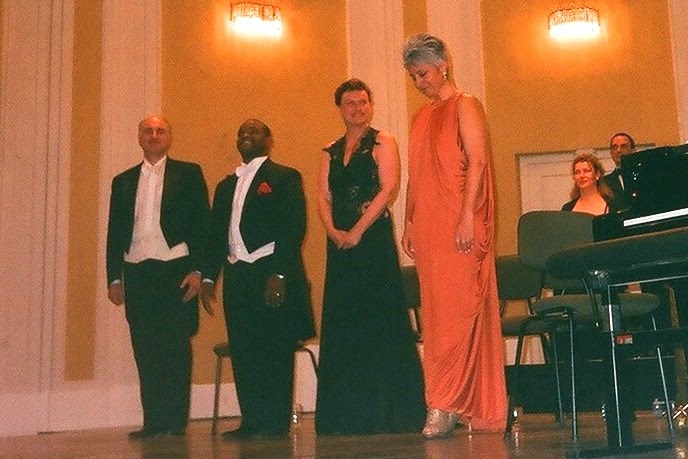
There were only
two downsides to the concert. The first
was the balance between the two pianos (the only instruments apart from a
harmonium) and the voices. Although I
was in the front row, I had the misfortune to be the pianos’ side and they at
times overwhelmed the voices. (However,
I think that the awkward balance was only emphasised by my particular
seat. I sat further back in the same
hall the next day for Joyce DiDonato’s recital and the way that the venue
favours the instrument over the voice was still apparent.) The other downside was that one of the two
pianists was also the conductor. Normally Antonio Pappano is one of the most considerate conductors to
his soloists. Perhaps it was because of
his over-exertions on a day on which he had already conducted Rossini’s Stabat
mater but it was evident that Sir Tony had his head in the score rather
than the score in his head. Oft times
the soloists looked to him for guidance but they rarely got it. It was clearly a performance in which some of
the individual parts (the chorus and the soloists) had done their own very
careful preparation but the ensemble as a whole was under-rehearsed. Still, somehow it all came together
reasonably well despite that.

After an hour’s
break, it was time to move to the main venue of the Festival for its
centrepiece: the Grosse Rossini-Gala.
A galaxy of stars had been promised on the bill but a number of them
(such as Agnes Baltsa, Teresa Berganza, Montserrat Caballé, Ildebrando
d’Arcangelo and Erwin Schrott) didn’t turn up. Fortunately Juan Diego Flórez offered his services at the last minute
and his duet from La Cenerentola with Cecilia Bartoli (the two of them
appearing opposite each other for incredibly the first ever time) was one of
the highlights of the evening. The
desertion of so many singers meant that not only was the evening a soprano-free
zone (not entirely inappropriate for Rossini) but there were in fact only two
female singers onstage throughout the gala - being the two most famous
Zurich-based mezzos. After a succession
of male “opere buffe” pieces (which ranged from an excellently delivered and
genuinely funny Don Magnifico from Carlos Chausson to an over-confident Ruggero
Raimondi parting tempo from the orchestra throughout most of Basilio’s La calunnia
despite the best efforts of the baton of the otherwise supreme Adam Fisher),
the first half concluded with the Act I Finale from Il barbiere di Siviglia
featuring Kasarova as Rosina in her second frock of the night: a sleek,
silvery-cream number. As Bartoli was
already dressed in jeans, apron and yellow “Marigold” washing-up gloves for
Cenerentola, she took on the role of the servant Berta. Cue for much clowning between the two mezzos
miming severe backache as they exited from their curtain calls.

So far, the
programme had consisted entirely of such high jinks and this suited the
majority of the audience who had obviously come just for a fun night out. At the astronomical ticket prices charged,
only the financially unchallenged can afford most of the seats. Unfortunately, there is not necessarily a
correlation between wealth and musical appreciation. The social snobbery on display did not have
much to be snobbish about in regard to their cultural sensibility. The insensitive barrage of coughing
throughout the purely orchestral numbers was only amplified by the excellent
acoustics of the Grosses Festspielhaus; flash photography was taking place
during the actual performances; most distracting of all was the woman in front
of me who spent over half of the evening texting on her mobile phone. One wonders why she had bothered to come.
In this circus
atmosphere, it was obvious that the minority of serious arias on show would
prove a trial to this majority element in the audience. Frau Kasarova had the
misfortune to be the purveyor of such a piece when – as the first aria after
the interval – she delivered Arsace’s Eccomi al fine in Babilonia from Semiramide. Entering in frock three of the night (a
stunning scarlet number), she proceeded to surmount the varied vocal challenges
of this virtuoso aria. My only criticism
of her performance was that it featured more than usually a defect that has
sadly become of late more evident in some of her performances: a very audible
and distracting intake of breath between the musical phrases. That though was more than compensated by the
accomplishment otherwise on display in this most demanding of musical
showpieces. She received respectable
applause afterwards but deserved much more.

Much more to the
taste of this particular audience was the grandstanding of Javier
Camarena. The new boy on the block of
star tenors delivered Ramiro’s Si ritrovarlo io giusto from La
Cenerentola with the kind of tooth-grinding vocal excesses that excited
this audience into a standing ovation and a fulfilled demand for an even more
excessive encore. The other standing
ovation of the evening went to the veteran José Carreras – mostly, I suspect,
occasioned by his fame. However, in his
case, the standing ovation was richly deserved.
His voice may be slightly ragged round the edges compared to what it
once was but his artistry is undiminished. He brought a laser-like focus to Giocondo’s aria from Rossini’s first
opera La pietra del paragone. It
was a privilege to be present for this.
After that, all
that remained was for the majority of the cast to wrap up the gala with the Act
II Finale from Il barbiere di Siviglia with Kasarova and Bartoli back as
Rosina and Berta accompanied by one Figaro, two Counts, two Bartolos and no less
than three Basilios. It topped an
evening that was mostly enjoyable but – with a different audience and perhaps
with the presence of some of the no-show stars – might have been much more than
that.
That’s Salzburg
for you though. Its distinctly Disneyfied
brand of tourism breeds an atmosphere in which a multiplicity of frocks seems
more appreciated than artistry. Personally, I would have preferred the chance to employ more than one
Kleenex."
----------------------------
Vesselina Kasarova's official website
Updated unofficial performance schedule
Vesselina Kasarova's official website
Updated unofficial performance schedule
Monday, May 5, 2014
Nina Stemme kann alles!
Just having a self-repeating Nina Stemme moment... Seriously, the gal is a natural wonder!
Nina kann alles!!
Nina kann alles!!
Saturday, March 22, 2014
Guest post: Vesselina Kasarova in Samson et Dalila in Cologne (Köln) 2014
My fellow opera enthusiast friend John Carnegie traveled to Cologne to see Vesselina Kasarova in Saint Saens' Samson et Dalila earlier this week and kindly agreed to share his impression in this guest blog post below. Thank you, John!
Samson
et Dalila at the Oper Köln – 19th March
2014
(2nd
performance of the current revival of the 2009 production)
The performance did not
take place in the Opernhaus (which is currently a building site where a
completely new theatre is being constructed in place of the demolished former
one). Instead it took place in the
temporary Musik Dom venue that the Oper is using: a prefabricated structure
under a bright blue tent next to the railway station. It is a soulless shed with indifferent
acoustics but good sightlines that can only be accessed via some unpleasant
urine-drenched tunnels running under the station. Perhaps due to this (and the notorious
reputation of the production), the house was only 70% full.
 |
| Foto: Lefebvre |
Tilman Knabe’s production
- which is in contemporary costume with the Philistines as Nazi-like fascists
and the Jews as (well) Jews - is determinedly designed to épater le
bourgeoisie and some of le bourgeoisie were duly épated and
exited noisily at the end of Act Two when Dalila cut off Samson’s penis rather
than his hair. If the departees had
stayed for Act Three, they would have become even more upset when a
triumphantly smiling Dalila presided over a crowd of extras being stripped
naked, raped and machine-gunned.
Actually (to my surprise)
I thought that the production worked very well indeed and (although
melodramatic) it animated and illuminated the opera far more than the somewhat
decorous production in which Vesselina Kasarova first gave her Dalila a couple
of years ago in Berlin. What was even
more surprising was how Frau Kasarova entered completely into the spirit of
this production. She has always struck
me as a delightfully modest performer who (as one reviewer put it) has always
seemed more attractive when playing men than when playing women. (Even her Venus in Tannhauser was
relatively chaste.) Not on this
revelatory occasion when she turned on what can only be described as the
"the full Netrebko".
 |
| Foto: Lefebvre |
The production conceives
of Dalila as a thoroughly evil high-class prostitute whose pimp is the High
Priest. Languorously draping herself in
suggestive poses across a bed while wearing very little in the way of clothing,
Kasarova's Dalila was sensationally sexy - both visually (she must have been spending
all of her free time recently at the gym) and (most importantly) vocally. Her Dalila in Berlin (while she was
recovering from illness) had been somewhat tentative. Here all her vocal guns were in place and she
smouldered and then soared through the part. What a frustration it is that she is spending most of her time doing
concerts when (as with her Romeo in Munich when I last saw her live) she is
clearly at her peak of her powers as an opera artist.
As for the rest of the
cast, the other highlight was Samuel Youn (Bayreuth's current Dutchman) in
magnificent voice as the High Priest. His scene with Kasarova at the start of
Act Two was the vocal highlight of the evening. As Samson, Lance Ryan sadly displayed all the faults of an over-employed
Heldentenor. Starting the evening with a fearsome wobble in his voice, he
gradually became more secure as the evening progressed but his is not an
attractive sound and his acting was half-hearted to say the least. In the pit,
Antonino Fogliani (who conducted Kasarova's recent concert performances as Romeo
in Oslo) did an excellent job of standing in at the last moment for an
indisposed Claude Schnitszler. The
chorus and orchestra gave a good account of themselves despite the difficult
acoustics.
 |
| Foto: Lefebvre |
Overall, a sensational
(and sensationalist) evening.
................................................................................................
My friend Yvette also attended the March 19th performance and wrote her impressions on her blog, along with sharing a wonderful backstage photo of Frau Kasarova smiling to all the fans that couldn't make it to the show.
Monday, February 3, 2014
Music for after-winter-rain San Diego: Kasarova & Stoyanova sing Pique Dame duet.
We are FINALLY getting some winter-like weather here in seasonally tardy San Diego. It rained a bit last night. Not nearly enough, but every bit of moisture that reached the ground is very welcomed at this point of our prolonged drought.
Anyhow, it is cool and cloudy and utterly beautiful outside, though I'm still stuck indoor for a few more hours (work has a way of doing that to you)... and basically can't think of a more fitting music for the moment than the charmingly melancholic duet between Lisa and Polina from Tchaikovsky's The Queen of Spade. This one courtesy of the amazing Bulgarian dual of Krassimira Stoyanova (Lisa) and Vesselina Kasarova (Polina) from a live concert a year or so ago. It's a pirate recording, so the sound quality is iffy, but what does come through is earworm-worthy in my book!
Anyhow, it is cool and cloudy and utterly beautiful outside, though I'm still stuck indoor for a few more hours (work has a way of doing that to you)... and basically can't think of a more fitting music for the moment than the charmingly melancholic duet between Lisa and Polina from Tchaikovsky's The Queen of Spade. This one courtesy of the amazing Bulgarian dual of Krassimira Stoyanova (Lisa) and Vesselina Kasarova (Polina) from a live concert a year or so ago. It's a pirate recording, so the sound quality is iffy, but what does come through is earworm-worthy in my book!
Tuesday, September 3, 2013
Ducky Dvorak for a Hot Summer Day
Quack!!
Antonin Dvorak's Moravian Duets: Slavikovsky polecko maly & V dobrym sme se sesli. Edita Gruberova (soprano), Vesselina Kasarova (mezzo), Friedrich Haider (piano). From the two divas' joint concert in Feldkirch in 1999.
Tuesday, April 30, 2013
Kasarova mania: revisiting the 2008 Bulgarian Encounters Euromaxx series
Euromaxx's Bulgarian Encounters television documentary series hosted by Vesselina Kasarova aired in 2008, so I was surprised to find that the videos are still alive and active on the Deutsche-Welle archive! Anyhow, if you missed it, here are the links to the 6 clips (they're about 5 minutes long each):

1. The Artist: VK arrives back home for a visit. Cool chat with her one and only voice coach, Prof. Ressa Koleva, recounting some early roles and performances. A little rehearsal snippet from Berlioz's La damnation de Faust from 1999 Salzburg Festival.
2. The Opera: VK visits Sofia Opera House where she began her singing career. They still have her Nabucco costumes! A look at the (then) newly renovated auditorium, and a bit from her masterclass.
3. The Home Town: VK visits her hometown, Stara Zagora, meets old instrumentalist friends, show off the town's modern bar, the opera house, old Roman auditorium, town centre & park.
4. The Cuisine: A trip to the town's farmers' market before tossing up delicious Shopska salad and an impromptu jamming session of the folksong 'Melodiya' with her harpist & flautist pals.
5. The Wine: A visit to the Katarzyna Winery, whose sweet red caused her to break into song ('Kalimanku, denku').
6. The Rose Oil: How rose oil is made at Bulgaria Septopolis, the scent of Bulgaria!

1. The Artist: VK arrives back home for a visit. Cool chat with her one and only voice coach, Prof. Ressa Koleva, recounting some early roles and performances. A little rehearsal snippet from Berlioz's La damnation de Faust from 1999 Salzburg Festival.
2. The Opera: VK visits Sofia Opera House where she began her singing career. They still have her Nabucco costumes! A look at the (then) newly renovated auditorium, and a bit from her masterclass.
3. The Home Town: VK visits her hometown, Stara Zagora, meets old instrumentalist friends, show off the town's modern bar, the opera house, old Roman auditorium, town centre & park.
4. The Cuisine: A trip to the town's farmers' market before tossing up delicious Shopska salad and an impromptu jamming session of the folksong 'Melodiya' with her harpist & flautist pals.
5. The Wine: A visit to the Katarzyna Winery, whose sweet red caused her to break into song ('Kalimanku, denku').
6. The Rose Oil: How rose oil is made at Bulgaria Septopolis, the scent of Bulgaria!
Wednesday, April 3, 2013
Vesselina Kasarova in South America
Vesselina Kasarova is in South America. Yes, South America, concert-touring Brazil and Argentina with Florian Donderer and the Camerata Bern! I'm a bit crossed at American concert halls and theaters for not managing to get her to stop by and do a few concerts in the USA on her way there (or back), actually, but I'm nonetheless very happy for VK's South American fans for finally getting to experience this exquisitely unique Bulgarian mezzo live on their own continent.
(Tancredi's entrance aria: O, patria - di tanti palpiti)
(Sesto's act II: Deh, per questo istante solo from La clemenza di Tito)
(Cherubino's 'Voi, che sapete' from Le nozze di Figaro)
Sesto's 'Parto, ma tu ben mio' from La clemenza di Tito
Thanks very much to her South American fans for filling the venues and sharing their experience with the rest of us on the internet. Drop in at Bella's Unexpected Song Blog for her account of the concert and green room experience in English. More fan reactions can be found at VK's (unofficial) facebook page (you must be signed into facebook to view it), too!
Edited to add concert review:
- Estadao
- Seen & Heard International
(Tancredi's entrance aria: O, patria - di tanti palpiti)
(Sesto's act II: Deh, per questo istante solo from La clemenza di Tito)
(Cherubino's 'Voi, che sapete' from Le nozze di Figaro)
Sesto's 'Parto, ma tu ben mio' from La clemenza di Tito
Thanks very much to her South American fans for filling the venues and sharing their experience with the rest of us on the internet. Drop in at Bella's Unexpected Song Blog for her account of the concert and green room experience in English. More fan reactions can be found at VK's (unofficial) facebook page (you must be signed into facebook to view it), too!
Edited to add concert review:
- Estadao
- Seen & Heard International
Monday, February 25, 2013
Earworm: Vesselina Kasarova does Tchaikovsky's Joan of Arc
My computer has been giving me the blues lately. Two separate bouts of the dreaded unresponsive blue screen in a week is enough to rattle even yours truly. So now that I've paid much of an arm and got the laptop fixed I'm indulging in a bit of my tried and true antidote to all degrees of rattledness... Vesselina Kasarova singing anything Slavic
In this case, the timeless clip of young VK (probably from the early 1990's) conjuring up Tchaikovsky's vision of St Joan of Arc, convinced of future victory and saying good bye to her hometown before riding off to make history, in a particularly stirring rendition of the Act I ending aria. From her many interviews I perfectly understand why Kasarova has avoided taking Slavic roles in the early part of her career... but man, her voice and musical pathos go so well with Tchaikovsky you don't even have to understand the sung Russian to get what she's airing!
PS: Keep the player going after Joan's aria for a really splendid Princess Eboli, too, if you have time. I know some people find Kasarova's singing body & facial movement distracting, but I find it endlessly fascinating. You can actually see where she's finding all those fantastic vocal colors to dramatize her sound with. The whole body as a virtuoso dramatic singing instrument!
In this case, the timeless clip of young VK (probably from the early 1990's) conjuring up Tchaikovsky's vision of St Joan of Arc, convinced of future victory and saying good bye to her hometown before riding off to make history, in a particularly stirring rendition of the Act I ending aria. From her many interviews I perfectly understand why Kasarova has avoided taking Slavic roles in the early part of her career... but man, her voice and musical pathos go so well with Tchaikovsky you don't even have to understand the sung Russian to get what she's airing!
PS: Keep the player going after Joan's aria for a really splendid Princess Eboli, too, if you have time. I know some people find Kasarova's singing body & facial movement distracting, but I find it endlessly fascinating. You can actually see where she's finding all those fantastic vocal colors to dramatize her sound with. The whole body as a virtuoso dramatic singing instrument!
Tuesday, January 8, 2013
A Touch of Broadway: Paloma San Basilio Does Evita
It's a bit weird, but somehow Broadway musicals have been going well on my mp3 player when I'm our riding up endless upslopes in the eastern mountains. I know a lot of opera fans have quite a lot of disdain for one Andrew Lloyd Webber, but the man sure knows how to compose tunes that stick to your ears. One of his many hits is, of course, Evita's famous 'Don't Cry For Me, Argentina'.
Like many, there is no Evita like Julie Covington for me... but when it comes to the show's flag tune, she has serious competition in the Spanish version by Paloma San Balisio. I mean... how the heck does she sing like that with tears rolling down her cheeks anyhow?
Like many, there is no Evita like Julie Covington for me... but when it comes to the show's flag tune, she has serious competition in the Spanish version by Paloma San Balisio. I mean... how the heck does she sing like that with tears rolling down her cheeks anyhow?
Monday, January 7, 2013
2013 isn't 'next year' anymore!
Hey, the year changed on us! Do you still catch yourself writing down 2012 when you have to write down a date on a sheet of paper or when you type one onto a form?

2012 sure was an eventful year. Yours truly moved to yet another apartment with another roommate (a real keeper, if you ask me), got a bicycle and ditched the cane - which means I'm speedier if not all that much more stable, I suppose.
I'm afraid I didn't go to enough concerts and performance arts events last year. Not because there wasn't any good show, mind you! Hopefully I'll manage to show up at the various concert halls and theaters more this year. The San Diego Opera is putting on five very different shows this season starting with Donizetti's operatic romantic comedy that is La fille du regiment (Daughter of the Regiment) on January 26th. It features L'Ubica Vargicova and Stephen Costello as Marie and Tonio. Even more irresistible for mezzophiliac me are the two supporting ladies in the cast: Ewa Podles as the Marguise and Carol Vaness as the Duchess.
It's winter here in America's Finest City, however, which means that the days are cold (or even cold) enough for long cycling rides in the eastern mountains. So when it isn't raining and the job isn't demanding too many daylight hours I am to be found huffing and puffing up the gorgeous roads east of town, preferably going up Mt Palomar by South Grade Road (S-6) and coming down East Grade (S-7) for a nice view of Lake Henshaw, or along the many mountain highways between the Poway and Julian... or in the mountains south of Alpine.
A lot of climbing... But that's how it goes, my friends. No pain, no view! The last time I went riding around the Great Western Loop (the big mountainous loop formed by Dehesa Rd, Japatul Rd, Lyons Valley Rd and Jamul Dr) I put the camera's video feature to good use and made the above video. Bonus points if you can identify the soundtracks!
Anyhow, thanks for stopping by. Hope 2013 has started well your way and keeps getting even better!

2012 sure was an eventful year. Yours truly moved to yet another apartment with another roommate (a real keeper, if you ask me), got a bicycle and ditched the cane - which means I'm speedier if not all that much more stable, I suppose.
I'm afraid I didn't go to enough concerts and performance arts events last year. Not because there wasn't any good show, mind you! Hopefully I'll manage to show up at the various concert halls and theaters more this year. The San Diego Opera is putting on five very different shows this season starting with Donizetti's operatic romantic comedy that is La fille du regiment (Daughter of the Regiment) on January 26th. It features L'Ubica Vargicova and Stephen Costello as Marie and Tonio. Even more irresistible for mezzophiliac me are the two supporting ladies in the cast: Ewa Podles as the Marguise and Carol Vaness as the Duchess.
It's winter here in America's Finest City, however, which means that the days are cold (or even cold) enough for long cycling rides in the eastern mountains. So when it isn't raining and the job isn't demanding too many daylight hours I am to be found huffing and puffing up the gorgeous roads east of town, preferably going up Mt Palomar by South Grade Road (S-6) and coming down East Grade (S-7) for a nice view of Lake Henshaw, or along the many mountain highways between the Poway and Julian... or in the mountains south of Alpine.
A lot of climbing... But that's how it goes, my friends. No pain, no view! The last time I went riding around the Great Western Loop (the big mountainous loop formed by Dehesa Rd, Japatul Rd, Lyons Valley Rd and Jamul Dr) I put the camera's video feature to good use and made the above video. Bonus points if you can identify the soundtracks!
Anyhow, thanks for stopping by. Hope 2013 has started well your way and keeps getting even better!
Wednesday, December 12, 2012
Something to look forward to: Christiane Karg - Amoretti
Christiane Karg, the wonderful young German soprano, has a new CD out:
Mozart, Gluck & Gretry... How cool is that! Not only do I get to hear her sing some more, but I also get to hear rarely heard music from the period I really dig, too! A nice continuation from my first experience of her in the Salzburg Festival DVD of Mozart's Apollo et Hyacinthus.
That's another awesome bit of music that's not performed anywhere nearly as often enough at all...
And to add icing on the cake, she actually granted me a cyber interview a few years ago.
Mozart, Gluck & Gretry... How cool is that! Not only do I get to hear her sing some more, but I also get to hear rarely heard music from the period I really dig, too! A nice continuation from my first experience of her in the Salzburg Festival DVD of Mozart's Apollo et Hyacinthus.
That's another awesome bit of music that's not performed anywhere nearly as often enough at all...
And to add icing on the cake, she actually granted me a cyber interview a few years ago.
Subscribe to:
Posts (Atom)